The school library can reach across every priority area in a school, but ten years working as a school librarian, followed by just under a decade working in education charities, has shown me it is too often one of the most underused assets. I have seen time and again where a school library could be transforming lives, and I have seen what is lost when it simply isn’t used.
This might not be obvious to you. After all, the recent PISA results show that England is doing brilliantly when it comes to reading. But whilst PISA may have demonstrated our success at teaching children how to read, they told us very little about what children are doing with that skill.
The truth is that reading for pleasure is at a big enough crisis point to prompt a National Year of Reading and to set off Select Committee hearings in Parliament.
What’s going on?
We know that children are not choosing to read for pleasure and it’s impacting their attainment, their wellbeing and their ability to understand the world around them. As a response to the sharp decline in reading engagement recorded in 12– to 13-year-olds, we have recently launched Reading Reboot, a reading programme funded by the Charlotte Aitken Trust targeting Year 8s who don’t choose to read.
The programme builds on a pilot which demonstrated that reading initiatives work when they are run by a school librarian, in the school library, and with the right support and books in place. Pupils who participated in the pilot showed as much as a fifteen-month increase in reading age after just 12 weeks.
As government looks to implement a new Year 8 reading test, we are interested to see what our scale up of the pilot tells us through a robust evaluation led by the Open University and supported by Renaissance Learning.
Personal skills and mental health
As well as helping to improve literacy and attainment, school libraries have a demonstrable impact in supporting better wellbeing and the development of empathy.
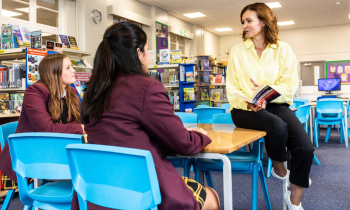
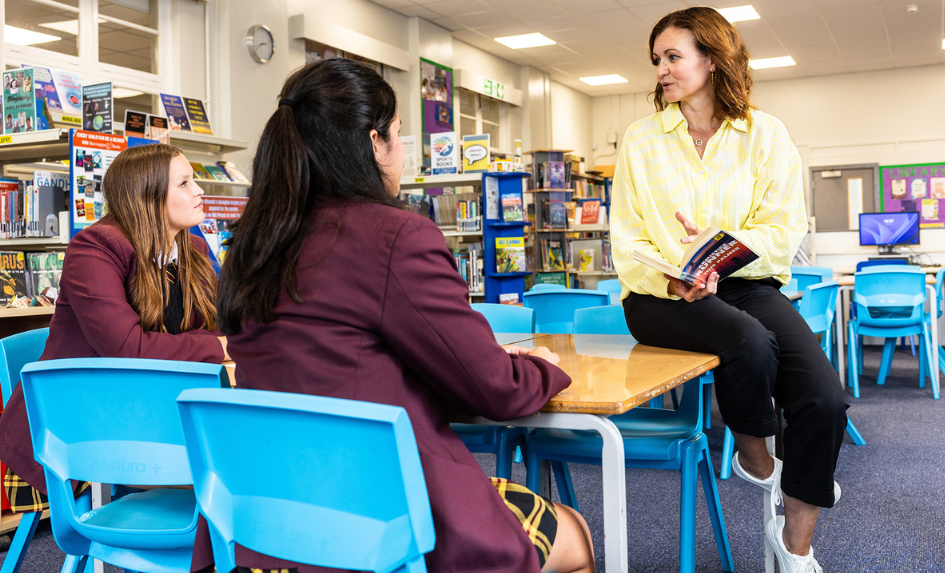
I saw a girl, whose lack of confidence had been crippling, lead parents evening activities with visiting families after just six weeks as a pupil librarian. A boy whose autism meant the playground was just too much, entered the library with a big smile on his face, because he had found a safe haven.
There were the young people who loved opportunities to debate and discuss which book was the must-read of the moment. And a girl who had no access to books at home would sit outside the library at 7:30 every morning desperate to read whilst she had the opportunity.
The list could go on, but as one headteacher put it “Our library is the heart of our school’s reading community, helping every child see themselves as readers and laying the foundation for lifelong library use.”
The benefits of a school library
School libraries and librarians can do so much more than simply house and manage a book collection. When properly funded and resourced, the school library can positively impact every priority in your development plan:
- Curriculum and attainment: Timetabled library lessons can support literacy, language, contextual knowledge, media and information literacy skills and critical thinking for all pupils.
- Disadvantaged students: The school library offers free access to books where none may exist in the home. With time, resources and a well-supported librarian, this advantage can also extend to pupils’ families – for example, with opportunities for parents, carers or younger siblings to visit the school library after school.
- SEND and inclusion: An accessible, inclusive space, filled with books that reflect the school community, and help and advice from an expert on hand to support reading choices, can ensure every child is supported.
- Wellbeing and belonging: We know that UK children don’t feel a sense of belonging in school compared to other countries. As concerns around pupil wellbeing grow, a welcoming space and opportunities to become part of the library community, with pupil librarian schemes, reading clubs and other enrichment, is precious beyond measure- and proven to positively impact wellbeing.
- Media and information literacy: AI is inescapable, and as our children navigate increasingly complex digital landscapes, the skills needed to unpick information are paramount. Many librarians are experts in information literacy and critical thinking; their knowledge will never be more valuable than at this time.
Advocating for libraries
I referenced all of these benefits while giving evidence to the Education Select Committee Reading Inquiry this summer, and the Committee went on to put all of my recommendations to the government. This includes the recommendation for school libraries to be placed on statutory footing, with funding for books, training and resources provided:
“School libraries are not optional enhancements but essential infrastructure—powerful equalisers that ensure every child, regardless of background, can engage with reading and realise their potential”
This is what I would like all school leaders to know about school libraries. In an ever-changing education sector, the positive impact of a school library is constant. If prioritised and used with purpose, a school library could make a fundamental difference to every child, teacher, and parent in your school community.
Victoria Dilly is CEO of the School Library Association, the only UK charity dedicated to supporting school libraries and the children and young people who benefit from them. Before taking up the post in 2025, Victoria worked in education for 20 years, initially as a school librarian herself and then leading national education programmes for organisations such as National Literacy Trust, Royal Horticultural Society and Young Enterprise. She has a wide range of experience and expertise and a firm belief in the transformative power of literature.
The School Library Association is a national education charity that supports schools in developing and delivering successful school library provision. In 2027, the SLA will celebrate its 90 year anniversary with a national campaign highlighting the impact of school libraries for all children and young people.