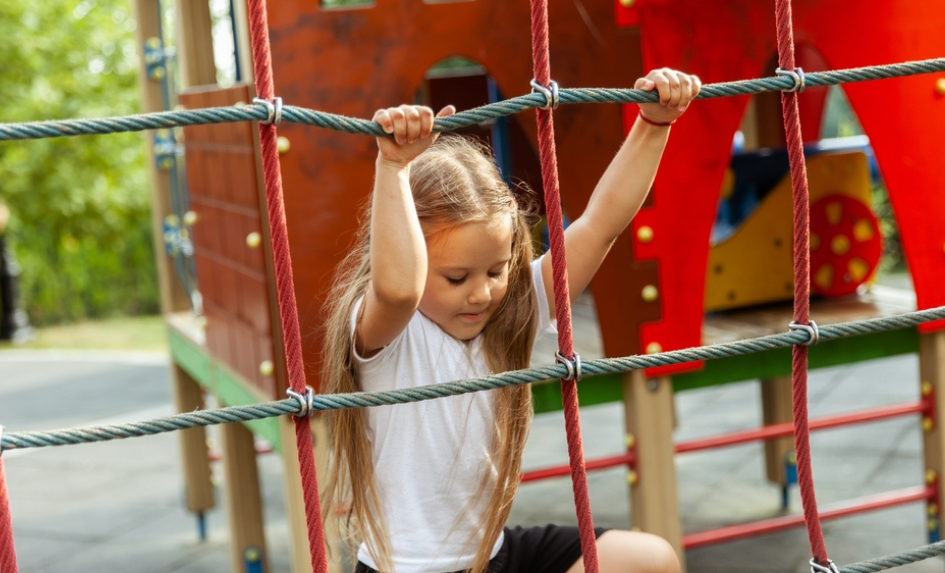
Outdoor playground equipment is one of the hardest-working assets on any school site.
In the vast majority of cases, it’s used every breaktime and every lunchtime. Possibly by breakfast clubs, afterschool clubs and holiday schemes, too. Proper inspection and maintenance practices can pre-empt required repairs and upkeep, preventing any unnecessary downtime.
The relevant British Standard for playground installation and inspection mandates yearly professional inspections, but there’s some room for interpretation in terms of daily inspection. With that thought in mind, here are a few key tips that the best headteachers are employing to ensure their playground is always safe for use.
Managing responsibility
The Department for Education makes it clear that the employer holds overall responsibility for health and safety. This is set out in their guidance on good estate management for schools. The same document states that, while the management of specific tasks can be delegated, the legal duties themselves can’t.
The employer in this instance depends on your type of school. For community and voluntary-controlled schools, the employer is the local authority. For foundation and voluntary-aided schools, the governing body is the responsible party. For academies and free schools, it’s the academy trust.
On a day-to-day basis, however, the employer often delegates site management to headteachers. Passing daily checks onto a site team or contractor is fine – but the headteacher is still the one the employer will look to for assurance that the site is safe and usable.
Understanding inspection levels
The key standard that your school’s playground needs to live up to is BS EN 1176-7, which is the part of the playground equipment standard that covers installation, inspection, maintenance and operation.
The British Standard sets out three tiers of inspection that you must adhere to:
- Routine visual inspections – think tackling obvious, everyday hazards like litter, broken glass and vandalism.
- Operational inspections – more detailed, hands-on checks on whether your equipment is stable and operating as it should.
- Annual main inspections – a thorough assessment of the equipment, its foundation and the surfacing beneath. These must be carried out by an independent party.
Each of these plays a key role and must be work together to ensure ongoing safety for your school’s children. Here’s how to ensure every aspect of your inspection strategy is taken care of.
1. Routine checks
Who can carry them out: Anyone
In schools, where playground use takes place daily and there’s a high number of children engaging with your playground equipment, routine checks must be carried out with more regularity than in a public playground, which might see more sporadic usage.
Daily checks are usually achievable and provide best visibility over your pupils’ safety. Having your site manager or caretaker carry out a quick sweep every morning, before pupils go out for playtime, can usually be done in as little as ten minutes, and catches most problems early.
You don’t need specialist knowledge for this. Just ask your staff to look for things like:
- Glass, litter, sharp objects and animal fouling
- Broken, loose or missing parts
- Splintered timber or sharp edges
- Worn, lifted or displaced surfacing
- Bark or other loosefill that might’ve been kicked away from landing areas.
2. Operational inspections
Who can carry them out: Someone with knowledge of playground safety standards
Operational inspections must be executed at intervals between one and three months and require a higher level of specialist knowledge. These inspections should only be carried out by a competent person who has received training and has a working understanding of playground safety standards, whether that’s a trained member of your team or an external contractor.
As part of this inspection, whoever you’ve chosen to carry out the work must examine any moving parts and connections, check for corrosion or loose fixings and assess timber for any early signs of decay. Another key aspect will be considering whether your impact-absorbing flooring and surfacing remains intact and correctly positioned.
For best practice and to give you and your staff peace of mind, I’d always recommend actioning an operational inspection closer to monthly than every three months.
3. Professional inspections
Who can carry them out: An accredited professional
The final and most in-depth form of inspection is the professional inspection, which – as the name suggests – must be carried out by a professional, accredited by the Register of Play Inspectors International (RPII) or another equivalent body.
Actioned yearly, this type of inspection provides a full, in-depth review of every piece of equipment and results in a written report that details the equipment’s condition, underpins your (and your employer’s) duty of care and provide an auditable record in the event of an incident or insurance claim.
Aligning these with the summer term is usually recommended, so that any required repairs can be actioned during the summer holidays while pupils are away.
Recording documentation
The Department for Education lists your inspection logs and registers as one of the documents that your school should hold. If anything does go wrong, then those records will provide proof that your playground equipment has been properly managed.
My top tip here would be to make sure that reporting any issues is as easy as possible, whether that’s your site team reporting on the daily condition of the equipment, a more in-depth operational inspection or the annual accredited inspection.
Give your team the correct channels to flag any concerns and you’ll find that you’re spotting and documenting any small issues before they spiral into bigger problems.
Barry Leahey MBE has been President of Playdale Playgrounds since 2004. He started his journey with Playdale as the Sales & Marketing Director. Responsible for introducing children abroad to Playdale’s innovative playground equipment, Barry’s driving influence is bringing laughter and play to children across the globe.
Barry was awarded an MBE in 2017 for contributions to UK trade and exports. He has also been recognised as North West Director of the Year, features on the Daily Telegraph’s list of the UK’s Most Ambitious Business Leaders and is an active supporter of children’s charity NSPCC.